Which lighting system should you get for your planted aquarium?
It’s a great question and it’s one that I still ask myself when buying equipment for a new setup. They do more than just light up the tank. They’re one of the three major factors in plant health and growth along with nutrients and CO2.
There’s a science to picking out the right lighting system with factors to consider like lighting spectrum, PAR, and lumens. But since you’re new to the hobby, I’m not going to dive into all of those. I’ll save those topics for a later article.
Today, I’m going to make it simple for you so that you can buy your first light and get to setting up your aquarium. I’ll talk about:
- Why plants need light
- How much lighting you need based on the plants you have
- My favorite lighting system for planted tanks
- Troubleshooting for light issues (algae, stunted growth)
Plants need light to grow
In the wild, the plants get the light they need from the sun. They use that light to photosynthesize, which is the process of converting light into energy. This energy is used to grow and convert carbon dioxide to oxygen.

In your aquarium, you’ll use artificial lighting to replace the sun because it’s controllable. There are different types of lights but I recommend LEDs. They’re the most energy-efficient, consuming less power while providing better light output.
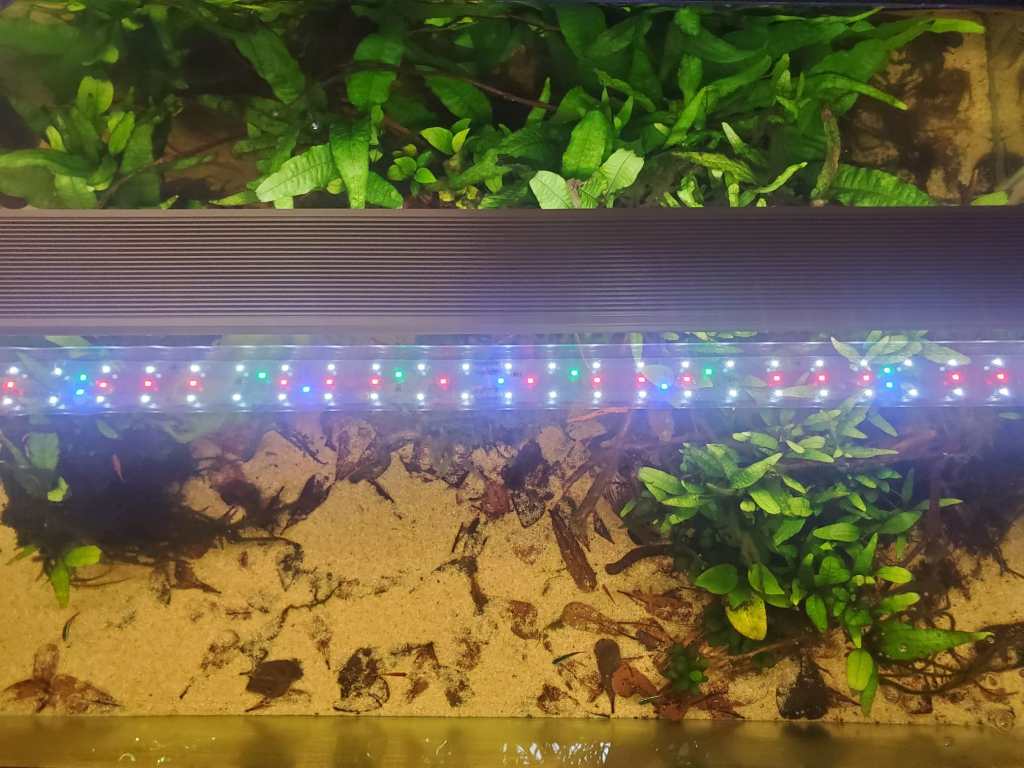
Also your light should have a RGB (red green blue) spectrum. Those are the colors that plants absorb the most of and need to photosynthesize and grow.
So … you’ll want an LED light with red, green, blue colors, like in the image above.
Choose your light based on your neediest plant
Next, you’ll look for a light that meets the needs of the plants in your aquarium. I’m sure you’ve seen bios that say if a plant is “high-light” or “low-light.”
There are a few ways to measure the intensity of your lighting system. The two below are the most common metrics you’ll see when searching for a light:
Watts:

Lumens:

But the most accurate and the best indicator of lighting intensity is Photosynthetically Active Radiation (PAR). PAR records the amount of light available for photosynthesis. The PAR numbers are provided by the manufacturers so you just have to get the suitable one for your aquarium.
PAR:
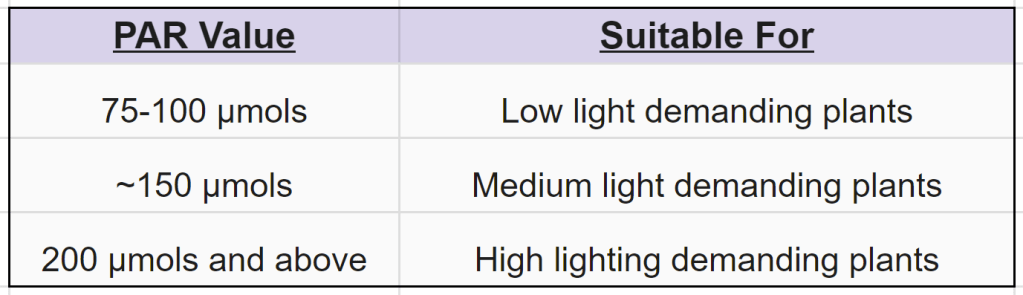
High light plants include species like Dwarf Hairgrass and lots of stem plants. These also often need CO2 supplementation to prevent algae and grow dense and strong.
You can find this information in the product descriptions of most light system brands like Twinstar. Otherwise, you’ll have to use a PAR meter, but those can cost upwards of $200.
Medium light plants are species like cryptocoryne. And java ferns, moss, and anubias are the most common low light species. These plants grow slowly and shouldn’t be kept in high-light setups.
My favorite lighting system is the Twinstar Series
I have mostly blackwater aquariums, so my current lighting needs are pretty low. But I’ve had high-energy setups in the past and on almost each one of them my go-to has been the Twinstar LED series.
My favorite is the Twinstar B Line lights. This series has the lowest light output, but again, I mostly have low-demanding plants.

Want to know which Twinstar light is best for you? Read this article by Buceplant.
Also, one of my favorite things, Twinstar lights are incredibly affordable and even more reliable. Even though it’s my top option, there are other lighting systems out there that are just as good. It’s ultimately up to you to decide, I just wanted to give you a good place to start.
What to do if you have problems with your lighting?
Once you get your light up and running on your planted tank, you might run into two big problems: algae and stunted plant growth.
Now there could be various causes for these, but the most likely is something to do with your light.
If you’re experiencing algae in your tank, it’s probably something to do with your lighting.
How long is your light on for each day and at what intensity? If your light is too strong for the plants you have, algae outcompete them for nutrients, resulting in an algae bloom.
If you start to see algae in your tank, try shortening the photoperiod (the time the light is on) in your tank. But make sure you’re not making drastic changes to the conditions.

On the other hand, your plants might not be growing because they’re not getting enough light. In either case, make changes slowly and over time.
Reduce lighting intensity gradually and change the photoperiod in 1 hour increments every 1–2 weeks. Plants don’t react immediately to changes in their conditions.
Lighting is a big part of your planted tank’s health and appearance. When you start to understand the needs of your plant and meet those needs with the right lighting system, you’ll be able to create a thriving, beautiful aquascape.
But remember, balance is key and it’ll take some tweaking in the beginning to optimize everything. That’s lighting in the planted tank in a simple and understandable way. Hope you learned something today. If you have any questions, please email me or subscribe to the newsletter to get weekly updates and tips.
Happy scaping,
Dom

 The Aquarium Home
Leave a reply to 7 Steps for Choosing and Growing Aquarium Plants – The Aquarium Home Cancel reply