
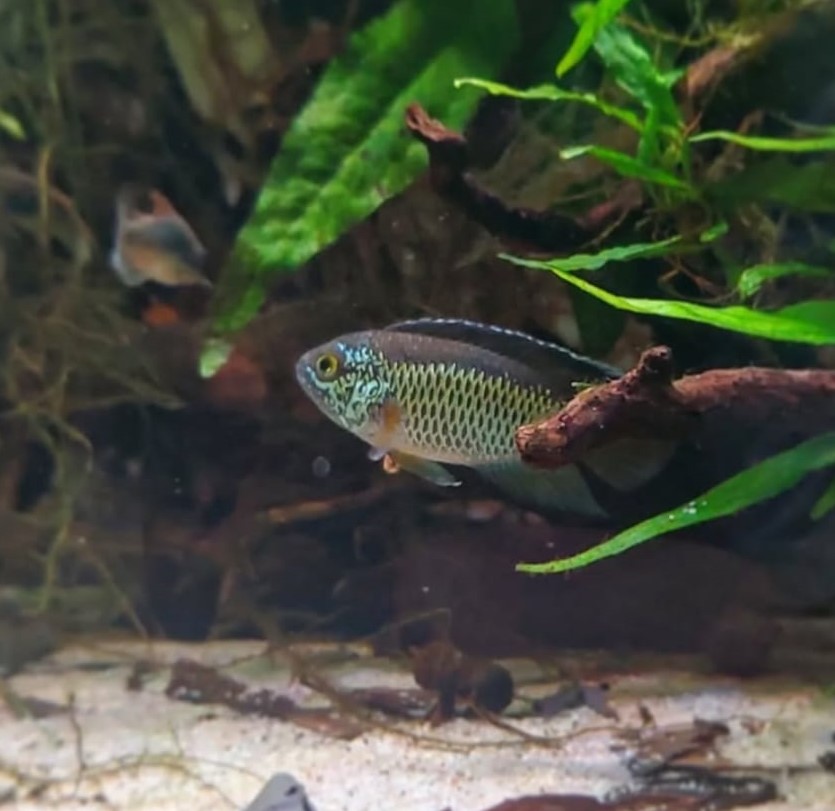
Fish are the focal point for all of our aquariums. Regardless of how your tank is scaped, our attention will always be on the fish.
In the hobby, the “function” of the fish can be broken down into two categories: dither fish and centerpiece fish. Dither fish are introduced to an aquarium to make other fish feel more comfortable and less stressed. These little helpers are usually small and active fish that swim in the upper or middle levels of the water (danios, tetras, or guppies).
The other category is called the centerpiece fish, a species of which I’ll be talking about today. Think of them as “the star” of your fish tank. They’re typically wonderfully colored, have personalities, and can be slightly bigger than the other inhabitants.
In today’s article, I’ll be giving you a care profile for one of my favorite centerpiece (and in general) fish, Nannacara Anomala, commonly called the Goldeneye Cichlid.
I’ll tell you the water parameters I keep them at, their temperament, fish mates, and I’ll tell you how I got them to breed several times.

Water parameters for the Goldeneye Cichlid
I bought three Goldeneye Cichlids from an aquarium store in Atlanta earlier this year. I asked them which cichlid would be best for a blackwater setup in a 120 gallon aquarium. They recommended this fish, and after doing some quick research on the spot, I bought them.
Goldeneyes are from South America. As with most South American fish in the hobby, this cichlid enjoys soft, acidic water between 72 and 77F. Here’s what I keep mine at:
- 6.4 pH
- 80 ppm TDS → 45 ppm GH
- 77F
And then obviously ammonia and nitrites are at zero.
These fish can be kept in harder water than I have mine at. I’m planning on adding Amano Shrimp and I’ll be raising the TDS (total dissolved solids) to around 120 ppm.
Goldeneye Cichlids need at least 20 gallons – length is more important than height. For example, if you have the choice between a standard 20G long and a standard 20G, I’d go for the 20G long every time.
Also I think you need driftwood and live plants for Goldeneye Cichlids. They’re naturally found in flooded grasslands in South America, so they love vegetation and cover. The more you provide (plus some dither fish), the more comfortable and active they’ll be.
These are the two tanks I’ve kept them in:

(40G Breeder)

(120G)
Temperament and tank mates
Nannacara anomala are very peaceful dwarf cichlids. Males grow up to about 3 inches and females are a little bit smaller. There can be a little bit of aggression between males, but not normally towards other fish.
I’ve kept my male with the following fish:
- Black neon tetras
- Neon tetras
- Ember tetras
- Corydoras catfish
I haven’t been able to get them to coexist with any species of shrimp yet – the male eats anything that can fit in his mouth.
Generally, any other peaceful community fish (especially from a similar region) can be safely kept with Goldeneye cichlids.
How I got them to breed
It’s very simple. I didn’t really do anything special to get these guys to breed. Males and females are easy to tell apart when they’re adults – males are bigger and blue. When females are ready to breed and protect their fry, they turn black and their lines really come out.

I had one male and two females and the male bred with both of them at the same time. In regular water conditions, a male and female are very likely to breed. It’s even easier in a larger tank with a number of females.
Females require “sub-territories” of at least 15in x 15in on the bottom of a tank, so a 30″ tank would be required to house two females with a male. The females will aggressively guard their eggs and fry.
Goldeneye cichlids are cavebearers, meaning that they’ll lay eggs in a “cave” and retreat into it with their fry during the night. It doesn’t have to be an actual cave, I’ve seen them use the underside of leaves, clay pots, and driftwood.

Goldeneye cichlids are one of my favorite fish because they’re so easy to care for, they’re hardy, and they’re easy to breed. Keep them in softer, acidic water with peaceful tank mates and they’ll be active and show natural behaviors.
If you’re looking for your first centerpiece fish and cichlid, I highly recommend you look for these first. I love watching them interact with other fish and their environment.
For more research on this fish and basically every other species in the hobby, I recommend using this site.
Happy scaping!
Dom
Leave a Reply